Showing posts with label Review. Show all posts

Tuesday, April 24, 2012

On O'Fallon Smoked Porter

And now for something completely different. Well, not COMPLETELY different, but O'Fallon Smoked Porter is quite different than the classic German rauchbiers I've reviewed so far. Put just about anything in American hands and it gets turned to the extreme (5/3 Burger, anyone?). Sometimes it ends in indigestion, and sometimes it ends in pure deliciousness. Luckily, in the hands of Brian Owens - Head Brewer - O'fallon Smoked Porter falls in the later category.

Smoked porter starts in the aroma with smoked meats, molasses, honey, and alcohol in that order. Quite nice. The smoke is evident, but not at all overpowering as it would be easy to do with such a beer. More BBQ than campfire.

Jet black with a brown head it starts thick but settles to a thin brown hat on top of a black tower of beer.
O'Fallon Smoked Porter
The taste is much like the aroma. The smoke is very unique. Very BBQ like. I never thought I would use catsup in a beer description (at least in a good way) but there it is, catsup! 

Of course there are the traditional porter flavors of roast malts and some molasses. Again not overpowering with the smoke but present with a thick, stick to your mouth feel on the palate. 

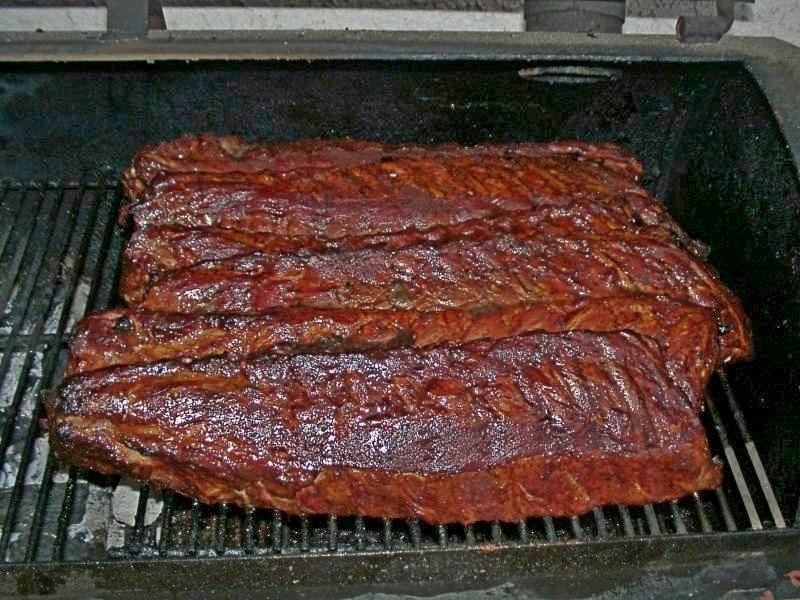
Overall this beer is liquid pork ribs in a bottle but somehow it works. Quite a nice, unique, creative beer. Very appropriate for a St. Louis based brewery.

Monday, April 16, 2012

On Aecht Schlenkerla Rauchbier Weizen

Last week I reviewed Aecht Schlenkerla Marzen, a smoked beer from Bamberg where smoked beers are a specialty. Today I'm reviewing another Aecht Schlenkerla beer, this time a wheat beer. That's right, April is going to be smoked beer month. Why? Well... why not? Smoked beers are wonderful and I don't think they get the credit they deserve among all the other specialty beers out there.

The world doesn't need another whiskey-barrel aged, sour, one-day-only, double imperial Russian stout. But a nice smoked beer provides excitement and differentiation without being in your face. I can only hope more craft breweries experament with smoke outside of the super strong realm and give a refreshing taste of smoke to complement all those summer burgers on the grill.

When poured krystal style the beer shows a dark amber color beneath a thick head of foam. Adding the yeast turns the color to a murky brown that isn’t quite as pretty, but well worth it in the end.

Spicy yeast phenols volly back and forth with smoke in an aromatic game of tennis that becomes more exciting the longer it lasts. Ultimately it’s the yeast that comes away with the win.

The smoke doesn’t make much of an appearance in the flavor, but in the same vein, traditional heffeweisen flavors are muted by the smoke that is there. Bready wheat malt and some clove anchor the flavor.

Dry and light, this is as refreshing as I’ve ever seen in a smoked beer. However, smoked beer lovers may find the smoke underwhelming, while heffeweisen lovers could find the smoke bothersome. This one never quite comes to a cohesive statement, but the individual elements are there.

Tuesday, April 10, 2012

On Aecht Schlenkerla Rauchbier Märzen

Aecht Schlenkerla is a classic German brewer that can trace it's lineage back to 1405 in Bamberg, a northern Bavarian town. It's here that the techniques used since before the discovery of the New World still survive. Sure, they use electric pumps, pitched yeast, and giant temperature controlled fermenters, but Aecht Schlenkerla still smokes its own malt in open fire kilns and ages it's beer in oak casks just like all beer was made up until the industrial revolution.

What this means is when you open one of Aecht Schlenkerla's Rauchbiers, you're opening a taste of history. Richard Wagner, Richard Strauss, Carl Orff, and Johann Pachelbel all lived in Bavaria and may have drank very similar beers while composing their most famous works. That connection with history doesn't come easy. It only happens through the careful adhearance to strict tradition through multiple generations. Aecht Schlenkerla survived The Reformation, near constant civil war, Napoleonic invasion, economic industrialization, two world wars, and reunification. Any of which could have prompted the owners to change their ways or close shop all together. And the simple fact that they did not, is reason enough to celebrate this fine beer.

Aecht Schlenkerla Rauchbier Marzen pours a dark golden brown with a white head that settles fairly quickly. Moderate lacing hangs to the glass. Oak smoke aroma backed by caramel and toasted bread notes.

Smoke and burnt sugar (you know, past caramel) start off the taste. Some roasty tones play backup. Non-smoked oak is also apparent in the flavor. Vanilla, marshmallow, toast. Add some chocolate malt and you’ve got a smore.

The palate is on the thick side with some lingering stickyness that doesn’t present as sweet so much as just thick or sticky.

The smoke is well balanced and complements the beer quite well. I hope the history and flavors of this wonderful brewery are kept alive for another 600 years.

Saturday, March 31, 2012

On Southern Tier IPA

I like labels. I've talked about their affect on me before with my post of Milten Gaither's label design for Brooklyn Sorachi Ace.  Labels say a lot about the beer you're about to spend your hard earned money on. Good labels - and packaging, in general - should tell you everything you need to know about the product. I'm not talking just about the name, or the description, or the logo on the front. The colour and the shape*. The texture, the size, and even the smell all play a roll in telling you what's inside. 

 So what does Southern Tier's packaging say about their IPA? Their labels tell me they are very particular about their products. There is nothing on the label that doesn't belong. The simple color scheme makes the 6 packs easy to find on the shelf. Just look for the sea of green (IPA, 2xIPA) or purple (porter) and you're on your way. Southern Tier is very pragmatic and efficient. Nothing is wasted. Everything in it's right place**. If there is a hop addition or a malt used, it has a reason. Nothing is just for the hell of it. The packaging has an organic look. Not to say that their beers are organic in the eyes of the USDA, but they portray an image of care for the environment in a down to earth, practical way. The consistency from beer to beer and from case to bottle to tap tell me that Southern Tier is detail oriented and I can expect that attention to detail to extend to their recipes.

The aroma starts with pine resin and earthiness. Like a walk through a redwood forest. Burnt orange color with a dense head that lingers.

Bitterness is well balanced with a touch of caramel (and honey?) sweetness. Pine and earthy flavors cary through from the aroma. Some minerals appear in the tail. Moderately long finish that isn’t overly sweet or bitter.

The balance stays throughout, never tipping from one side or the other, like a skilled tightrope walker. The medium body feels thick from the hops. I’ll be licking the insides of my mouth for a while.

Overall quite an enjoyable beer whose strength lies in its balance.


*good album, btw.
**good song, btw.

Wednesday, March 7, 2012

On Crispin Stagger Lee

Today I take a break from beer and give myself something a bit different to try: Cider. While there are similarities in the production, purpose, and - to some extent - history of these two beverages, cider and beer are very different drinks that test the beer drinker's palate. Accustomed to face contorting double IPAs, stupefying Russian imperial stouts, and sour Belgian's that make Warheads taste like water, the beer drinker may find it difficult to appreciate the subtleties of a fine cider. Cider is a rapidly growing segment of the craft beer world (can craft really claim cider to it's cause?). For 2011 the cider market has grown supermarket sales faster than any of the top 15 beverage alcohol segments with 27.5% growth. This compares to craft beer at 15.1%. True, cider is much smaller (about 20 times smaller) than craft, but it's growth is outstanding.

Premium cider brands such as Crispin have led the charge. Crispin alone saw over 200% sales growth in 2011 and brewers such as Boston Beer have joined the party. The man responsible for some of Goose Island's iconic brands, Greg Hall, has also gotten into the cider game and has planted cider apples in Michigan for his new venture, Virtue Cider. All this means more good cider for good beer lovers. So, in the spirit of broadening my horizons and trying something different, today I review Crispin's Stagger Lee: a blended hard cider aged in rye whiskey barrels.

Stagger Lee pours a cloudy yellow/orange with little head. Legs fall from the glass like wet paint.

The aroma starts with sweet apples. Whiskey is in the background but present. Clove esters. Maybe some banana esters as well, but hard to tell.

With the taste, whiskey, again in the background. Apple juice. The good kind. None of that apple drink mix. This is juicer fresh apple taste. I was hoping for more complexity and depth of character. The whiskey goes very well with the apples and this cider makes for a backwoods colonial history lesson. The whiskey comes out more as it warms; both in the flavor and aromatics.

Highly effervescent and full bodied. Residual sugars linger on the palate.

Overall, the cider/whiskey combo is delicious and I would like to try some of their other barrel aged offerings, but cider is still a bit on the sweet side for my tastes. I look forward to the budding cider industry. There is much to learn about this cousin to my favorite barley based beverage.

Monday, February 27, 2012

On Finch's Secret Stache Stout

Finch's Beer Company, based out of Chicago, has been open for less than a year and they have already extended distribution to Wisconsin and Indiana. Helped by their accessible Golden Wing (golden ale) and Cut Throat (pale ale) flagships, they are seeing quick success that must be demanded of their (relatively) large brewing capacity. Though the distribution extends wide, I did not expect any but the two core beers to be distributed outside their home market of Chicago. So I was pleasantly surprised to see Secret Stache Stout at my local Woodman's grocery store in Rockford.  And as I've said before, I like stouts.  So another stout on the market is good news for me.

The bottle represents a departure from their canned mainstays, and the artwork is quite interesting. A finch handing a beer to another bird that is being weighed down by a ridiculously large mustache. The reverse label shows an unlocked padlock sugesting that this may be the beginning of a limited edition series of specially branded brews.

Pouring a very violent pour produced almost no head. What there was was the color of medium toast. "soap bubbles" linger on the sides.

Not much going on aroma wise. Some general roast character and a hint of vanilla.

The taste is of espresso and vanilla. A bit of oak (probably from the vanilla, not actual oak) and alcohol linger in the finish. Medium-thick body and a lot of residual sweetness. This one is built like tank, but at 5.3% you can enjoy all 650ml without waking up the next day wondering what happened.

The low carbonation is perfect for the style. This would do well on nitro.

Overall, a mixed bag. I wish there were more aroma and a touch less sweetness, but the flavor and carbonation are spot on. Not bad for a bomber priced under $5. This is the best I’ve seen from Finch’s thus far.

Saturday, February 25, 2012

On Bud Light Platinum

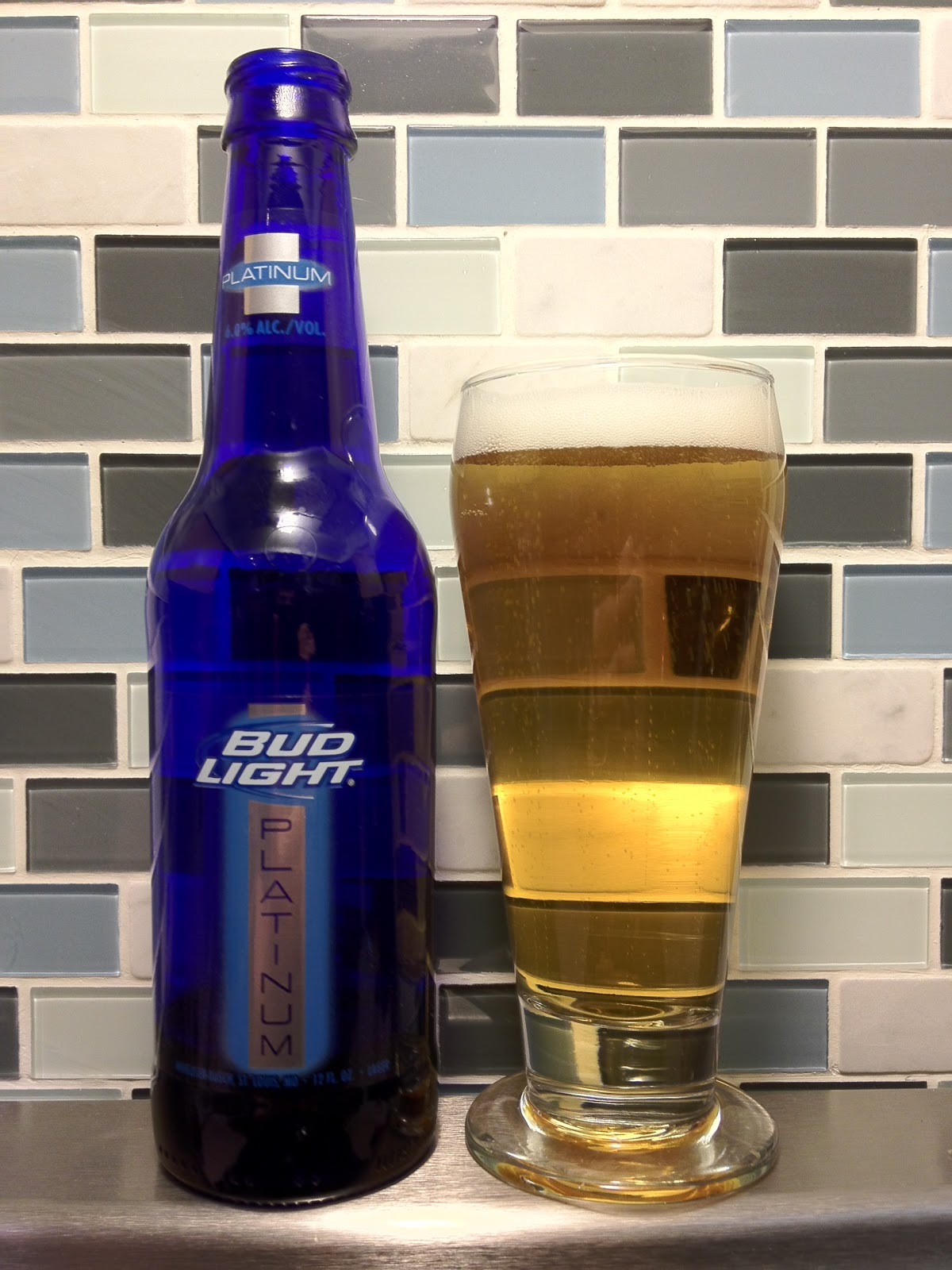
I know, I know. We're supposed to hate mass market lagers. They represent everything that craft beer is not. Big industrial machines pumping out vaguely yellow, vaguely flavored, slightly alcoholic water. But you know what? I don't care. The way I see it, beer is beer. Luciano Pavarotti, the popular singer, once said "I do not accept that the word 'pop' is a derogatory word. If the word 'classic' is the word to say 'boring', I do not accept it. There is good and bad music." Likewise, there is good and bad beer and just because it is made by a large, international company doesn't mean it can't be good. So when Anheuser-Busch InBev introduced Bud Light Platinum a couple of months ago, I decided I should give it a try. I was not disappointed.

Bud Light Platinum pours crystal clear and golden yellow. Slightly darker than regular Bud Light from what I remember. The snow white head dissipates quickly.

Slightly sour pilsener malt aroma. Flavor of sweet malt. A touch of honey, perhaps, but mostly just clean pilsener malt. Not as much adjunct flavor as regular bud light.

The body is the weak link and it borders on watery, but doesn’t quite cross that line. Highly carbonated and very drinkable.

Overall, it’s good for a BMC beer and I can appreciate it for what it is. This could be my weeknight drinker if it were a little lower in alcohol. But I guess that would defeat the point.

No, it's not the best beer ever, but when taken in context it holds its own. I happen to like light lagers and pilsners and Bud Light Platinum represents one of the best of the style. Miller may be playing catch-up with this one.


P.S. - I'm glad I like it... I had to buy a 12 pack.

Wednesday, February 15, 2012

On New Glarus Road Slush

Winter means stout, and in Northern Illinois (and Wisconsin, the home of this beer), winter means ice and snow. So today, in honor of the slush that I lovingly kick from my wheel well, I'm drinking New Glarus Road Slush. I've reviewed New Glarus previously and I have much respect for the brewery. Combine that with my love of low(er) gravity stouts, and this beer makes a perfect match.

Road Slush starts with lots of roasted aroma. Many stouts fall flat on aroma, but no this one. Full roasted aroma. That smell in fall when people are burning leaves... that’s this beer. Full. Warm. Inviting. Other aromatics of raw grain (oats) and a touch of honey.

The first taste brings out more sweet notes than the aroma. The taste of roast is still strong, but not quite as dominant. Coffee, chocolate and cherries come through. Some grain sits easy in the background. Just enough to keep things interesting.

The palate brings a bit too much carbonation for my taste. A beer of this caliber doesn’t need to hide behind 15psi of carbonation. Otherwise, the beer is quite smooth.

Overall, probably not the best oatmeal stout I’ve ever had, but it’s up there. The aroma is this beer’s strong suit and is what makes it unique.

Monday, December 12, 2011

On Mikkeller Single Hop: Simcoe

Simcoe is the name of the game today. My third in a series of reviews of Mikkeller's Single Hop Series (one and two here) showcases the Simcoe registered trademark hop.  Simcoe® can be a hard hop to get. Select Botanicals Group, LLC, the owners of the Simcoe® varietal, have only licensed three farms to grow the hop, all in Washington.

Simcoe starts with spices (pepper), earthiness, and some pine. A bit odd considering the citrus power of Simcoe hops, but the age may be a factor in this. I can't read the code date on the cap, but Rate Beer lists this as a retired style (get it while you can).

The color is dark redish-orange. Reminds me of the color of 70s carpet or upholstery. Moderate head retention leaves thin wisps of bubbles across the surface. In the mouth, caramel malt and piney hops give way to some citrus before mild alcohol finishes the show. The beer is medium bodied with medium-high carbonation. A bit oily.

Overall, this is the best of the single hop series I’ve had so far, but I do wish I had it fresher.

Single hop series reviews:

Monday, December 5, 2011

On Abbaye de Maredsous 8 Brune

Today is a day to celebrate.  Today is Repeal Day.  Seventy-eight years ago today the 21st Amendment to the Constitution of the United States, which repealed the 18th Amendment ban on the " manufacture, sale, or transportation of intoxicating liquors" was ratified, somewhat ironically, by Utah. The repeal of the 18th Amendment is a reason to celebrate. Not just because it restored the right of Americans to drink, but because it restored the right for Americans to conduct themselves in the manner of their choosing.

The 21st Amendment is not merely about being able to get rip-roaring drunk, it's about the most basic of American rights: freedom.  Freedom to drink.  Freedom to express oneself through a chosen art.  And freedom to experience the wide tastes made available through that artistic expression.  And so, today I celebrate.

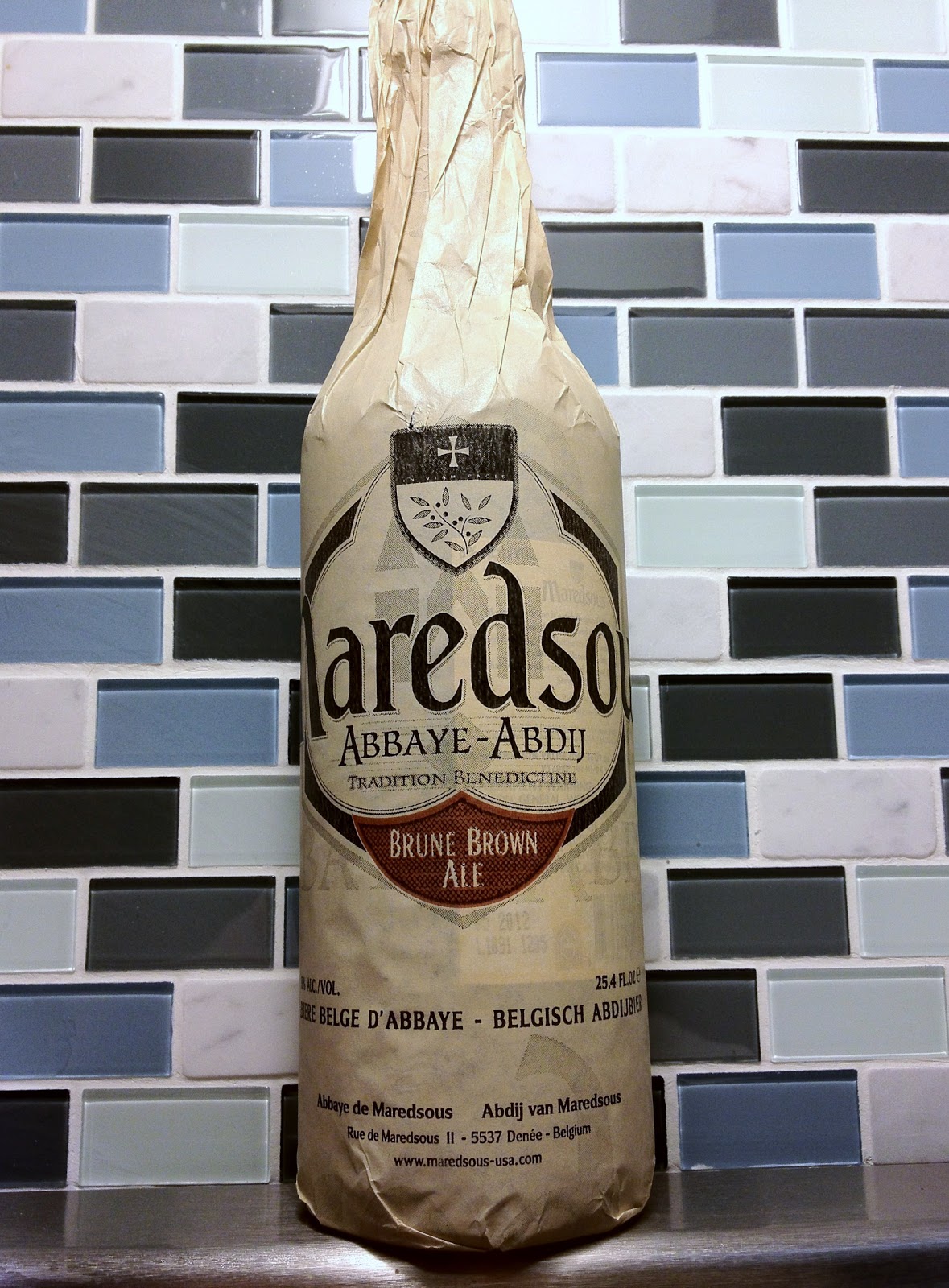
As it turns out, the dark ages of American beer were just beginning, but luckily today we have a few more options to celebrate repeal day than did the ciserones of 1933. And to that end, I'll be enjoying a bottle of Maredsous 8 Brune, a fine Belgian dubbel produced by Duvel under license from Maredsous Abbey.

The paper wrapping not only protects this bottle from exposure to light during it's 4,100 mile trip to Chicago and on store shelves, but it also implies mystery.  What could be behind the paper curtain?  It's a present waiting to be opened.  Once opened the hefty bottle continues its classic, medieval abbey theme (even though the brand originated in the 1960s), again begging you to taste the history and bygone lifestyle inside.  

"Drink Before: 05/2012" on the cork cage. Maredsous 8 presents itself with a dark, dark, ruby red - Nearly black - color and a long lasting, linen colored head with the consistency of whipped egg whites. Moderate lace clings to the glass.

Caramel, honey, fig, molasses, and chocolate dance an elephant ballet of aromas. Each are big and powerful but they gracefully whisp across the nose. The taste is similar to the aroma, but not as forward. Dark fruit and molasses pull forward first, then some honey shows itself. Hop bitterness balances the sweetness just a bit. The slightest bit of yeast autolysis comes in the end but it's not distracting and is perhaps to be expected in a bottle conditioned beer nearing the end of it's drinkability date. Lingering flavors of molasses and caramel present at the end.

Despite the diabetes educing descriptors of the aroma and flavors the palate is kept relatively clean by just enough carbonation and a surprisingly light body. Great beer.

Monday, November 28, 2011

On Goose Island Old Clybourn Porter (two ways)

On Black Friday I made a stop in at Goose Island's Clybourn Pub to buy their release of King Henry Barleywine. Unfortunately, they sold out in less than 2 hours and had to turn away over 70 people. But I was determined to get some beer so I took a seat at the bar. The opportunity that opened as a result was the chance to try the same beer not only on the typical keg draft system we are used to but also as a cask pour.

Cask ales saw a small surge in popularity a few years ago, but the cost of dedicating an entire tap (with incompatible equipment) to warm, flat beer made it somewhat of a fad and now few places other than a couple of hardcore British pubs offer cask beers. And it's a shame. A properly managed cask beer can be sublime. Heavy carbonation and near freezing temperatures can zap the more delicate malt and alcohol flavors and aromas from otherwise great beers. Being a British innovation it stands to reason that British style beers go great on cask systems, so I had a pull of Old Clybourn Ale from both keg and cask.

The differences in the two pours were apparent right off the bat. While both were a very nice, crystal clear, nearly black ruby color, The head on the cask pour (pictured on the right) was much more dense and formed some mild lacing down the glass, while the keg pour did not.

Both beers exhibited some roasted malt in the aroma but the cask version was a bit more forward in the nose. The taste was similar with roast malt up front with both. The keg version was a bit heavier on the chocolate and coffee tastes and was quite bitter from the roasted malts. The cask version was softer in the bitterness but showed some alcohol and a bit more dark chocolate flavors.

The big difference in the two beers was in the palate. The keg version had medium body and carbonation. Not nearly as smooth as the cask version, which was almost completely flat with just a light tickle of carbonation on the tongue. The cask version was also medium bodied.

Overall I enjoyed both beers tremendously, but the cask version wins this tasting set for both it's superior appearance and more complex flavor.

Monday, November 21, 2011

On Three Floyds Robert the Bruce

I don't believe any brewery has created such a devoted homebrew fanboy following as Three Floyds has. It seems every brew they concoct, no matter how wacky (Spazzerak! excepted) becomes an instant classic everyone must drink.  

Yes, I have made the pilgrimage to Dark Lord Day, and I enjoy my Gumballhead, but maybe, just maybe, Three Floyds isn't the Alpha King of craft beer. No need to turn Three Floyds into a Shangri-La of beer. Because if you do that, you stop thinking. And when you stop thinking, you turn into another yes-man. Another fanboy. Another boob willing to accept anything with three F's on the label as liquid gold. They deserve more respect than that. Be critical. Be honest. Be sincere. 

Take Three Floyds for what they are: another good craft brewery doing what craft breweries do: make good beer. And good beer is what they make, as evidenced by my latest tasting: Robert the Bruce. 

The experience starts with bitter malt and a bit of peaty aroma. As a Boilermaker, it saddens me to say that this is the perfect color combination of cream and crimson I have ever seen (such a shame from a Northern Indiana brewery). The head requires a violent pour to generate and it doesn’t last long before retreating to the sidelines. 

Clean malt character on the tongue is punctuated by cherry candy, caramel, and a touch of toffee. Sweet throughout and only slightly balanced by a low lying bitterness either from the roasted malts or hops. A bit cloying at the end, but perhaps that is to be expected from the bigger Scottish ales. The medium bodied and lightly carbonated beer goes down smooth but leaves behind a slightly sticky coating. Quite a nice beer. 

Well made and delicious - as I always expect from Three Floyds - but more complexity would be appreciated.

Thursday, November 17, 2011

On Mikkeller Single Hop Sorachi Ace

Next up in my Mikkeller Single Hop Series tastings is Sorachi Ace. This is my second exposure to Sorachi Ace; the first being with Brooklyn Brewing's Sorachi Ace. Common to saisons and IPAs, this relatively new hop from Japan is probably known most for its intense lemony aromas. With alpha acids over 10% it can easily be over bitter, but I think Mikkeller has done a good job to keep it in check. 

 The beer pours a cloudy, burnt orange color beneath a shallow carpet of white foam. Lemon and honey infiltrate the nose with a bit of warm biscuits. Not unlike a crumpet with lemon curd. 

Alcohol gives way to flavors of lemon and a bit of grass. Strangely, malt flavors are more apparent in the aroma than the flavor. Hints of grapefruit linger in the finish. This beer is medium bodied and exhibits lively carbonation with generally good balance that tilts to the malt side for an IPA. 

Lingering sweetness borders on cloying but doesn’t quite cross that line. This is my second exposure to Sorachi Ace hops, and the flavor is growing on me. I see this beer pairing well with whitefish or sushi.

Single hop series reviews:

Sunday, November 13, 2011

On Mikkeller Nelson Sauvin Single Hop IPA

Mikkeller out of Denmark has been performing a great service to aspiring beer afficianatos for quite some time now with their Single Hop Series.  This will be the first in at least 4 posts on Mikkeller's single hop series.  The idea, for those of you unfamiliar with Mikkeller's devotion to this project, is to brew the same exact beer and only change the hops.  From the label:
"For each version, the single hop  variety was used in the same weight for bittering, aroma, flavor, and for dry hopping.  All 18 varieties of single hop ales in this series were brewed the same week, from the same batches of malt, using the same yeast and fermentation temperatures." 
This differs from the Sam Adams Deconstructed project because the Deconstructed series of IPAs highlights the best of each of the hops in the Latitude 48 beer.  To highlight each beer, they do not necessarily use the same hoping rates for each of the different varieties, but instead make changes to best suit the individual hops.  While this likely creates a more appealing beer as a whole, it somehwhat diminishes the controlled study of a single hop beer series.

With the Single Hop Series we have a great library to evaluate the character of individual hops.  Additionally, the Single Hop Series can be used to evaluate malt character.  By evaluating not what changes, but what stays the same, it is possible to tease out malt qualities.


Nelson Sauvin starts with an unidentifiable berry candy aroma. Apple bars and  bit of funk bring up the rear. Appearance is a cloudy, burnt orange. The dense head recedes quickly. Heavy yeast sediment coats the bottom of the bottle. The flavor brings some caramel malt sweetness which gives way to an odd wine-like character. I like it, but it’s hard to pinpoint. An astringent hop bitterness continues in the long finish. Some alcohol warmth lasts in the back of my throat long after the last sip.

I think this bottle got some age on it from it’s trip from Belgium to Illinois (or I’m late to the party). The code on the top is 5??1010. If fresh, it would no doubt be better. The Nelson Sauvin hops are quite unique and I look forward to seeing them used more widely in the future.


Single hop series reviews:
Sorachi Ace
Simcoe

Monday, November 7, 2011

On Boulevard Sixth Glass

A special thanks to Tim for bringing this to me straight from Kansas City.

There comes a time in the development of every good beer drinker, home brewer, craft brewer, chef, and foodie where they develop a mild - or major - obsession with all things Belgian... at least when it comes to edibles.  Weather it be pommes frites with untold combinations of aioli or beers with untold combinations of complex flavors, the Belgians know how to create amazing flavor combinations.  Sixth Glass from Boulevard Brewing, like many American craft beers, takes on the challenge of crating a beer that stands up to the centuries of beer tradition found in Belgium.  They have succeeded.  

Sixth Glass is a complex "Quadrupel" ale and part of Boulevard's Smokestack Series.  The devil and lightning bolts on the early 20th century tonic-style label should serve as a warning to the elixir inside.  Sixth Glass proves to be as alluring as the snake oil pedaled at general stores one hundred years ago.  Just a sip turns into just a glass and just one more.

Sixth Glass pours the color of autumn leaves on an overcast day. The tan head sticks around just long enough to make some moderate lacing. A bit of coffee aroma immediately gives way to caramel and honey.... figs. A touch of ethanol reminiscent of rum. 

For taste, alcohol right off the bat. Gives way to caramel and dried fruit candy. Sweet but somehow dry at the same time. Probably due to the spicy yeast character. Mouthfeel is vinous with alcohol warmth to match and at 10.5% ABV, it’s not far off on it’s intoxicating powers either. 

Overall a quite complex beer that keeps you toasty - and tipsy - on a cold winter day. I suggest this beer for an alternative to red wine at a cheese tasting or with Spanish tapas. This is a sipper that should make an interesting pairing to many fatty foods.  I wish I had some more bottles of this.  It should only get better with age.  The best by on this bottle was 01/17/13.  Another year would have done wonders.  That said, this beer was highly enjoyable.  

Thursday, November 3, 2011

On Half Acre Lager Town

Half Acre Lager Town
When I think of Chicago and beer, I don't think of Goose Island, or Old Style... I think of Half Acre.  These guys put out an amazing number of different beers each year, many of them brewed just once.  The creative output of this small brewery is reflected in their use of amazing label art.  Each beer has a unique label that is nearly impossible to walk by without purchasing.  

I recently stopped by Half Acre's North Center brewery and picked up a growler of their current limited offering, Lager Town, an Oktoberfest... er, Novemberfest, style lager first tapped on October 28th.  The beer starts with clean malt aromas with a hint of toast. Maybe a touch of esters, but it could be my imagination. The small, white head quickly recedes to the sidelines revealing a dark, burnt orange beer underneath. Malt dominates for sure, but it has more earthy hop character than I am used to for the style - which is not at all a bad thing. 

This one starts out sweet and cuddly but gradually matures to a dry and pleasing end like a relationship between two old friends. A welcome change to some of the more cloying Oktoberfests from many American craft brewers. Full bodied with moderate carbonation, this well balanced Oktoberfest is very comforting on a wet, cold day.

Thursday, October 27, 2011

On Atwater Grand Circus

I had never heard of Atwater Brewery before today, though they have been around since 1997.  I needed something to go with my giant burrito I purchased across from my local wine/craft beer store and this can caught my eye.  The retro-style printing on the can from this Detroit based brewery was reminiscent of PBR, but inside was an IPA.  Intrigued, I made my purchase.  At 4.2% ABV Grand Circus is definitely on the light side for most of the American craft IPAs that many of us have come accustomed to, but more in line with standard British versions.  

Some light earthy hops and sweet corn in the nose. A touch of caramel. Shaving cream foam sits on top of a crystal clear light amber sea of beer. The head lingers for a long time, lifted by the constant bubbles from beneath. 

Taste is light with little hop flavor. I get mostly bready malts and some undefined fruitiness. Bitterness is a bit overpowering with no flavor backbone. Seems to be bitter for the sake of being bitter. Light bodied and goes down smooth. 

Overall it’s not that great of an IPA if you are looking for complexity and powerful flavors, but it would be good session beer for watching a ballgame or having a drink with "the guys". This paired well with the spicy burrito I had for dinner. Something to complement the food without getting in the way.

Thursday, October 20, 2011

On Great Lakes Edmund Fitzgerald

It's cold... And cloudy... And rainy.  Not a torrent, just a drizzle.  Just enough to be annoying.  Sounds like porter weather.  The roasty malts and alcohol should keep me warm.  And since it's my day off, I can have one.  I am fortunate enough to have access to one of the best beer bars in the midwest and possibly all of America:  The Map Room in Chicago.  This bar prides itself on a large selection of specialty beers and a knowledgable staff.  

Looking at the menu board I find a lot of Belgians and imperial IPAs. A downside of the unique beer bar is it's sometimes hard to find something "normal" - the beer equivalent of comfort food.  Luckily they had a porter.  The porter on tap: Great Lakes Edmund Fitzgerald.  A beer as mysterious and unexpected as the sinking of the ship it's named after.  

The aroma starts with  chocolate covered caramels and a bit of coffee. 

The Beer is black with an off white head that quickly recedes to a thin layer atop a sea of black. Minimal lace but a large meniscus around the inside of the glass. 

Tastes of dark fruit and roasted malts dominate but with a grassy/piney hop note. Medium bodied with a slick texture that coats the mouth. Carbonation is average. 

In the end, the hop flavor is a little distracting and I’d like to see more roasty malts, but overall this is a good beer for a such a dreary afternoon. Not the best of the style, but I would definitely order again.

Thursday, October 13, 2011

On Brooklyn Sorachi Ace


I've wanted to try this beer - and this hop variety - since it first came out on draft only in late 2009.  Unfortunately, I do not live in New York, so when Brooklyn Brewery came out with their Sorachi Ace in large format champagne bottles 6 months later, I was already watering at the mouth.  Alas, I resisted the urge to buy a full case off the bat.

The truth is, the elegance of the bottle scared me.  Designed by renowned graphic designer Milton Glaser, the simple lines and playful label design combined with the sexy curves of the neck and raised logo told me I was in for something more like a 1920s champagne bar than a tall boy at the tailgate party.  How could I possibly appreciate this beer to it's full potential?  Or, what if the beverage inside is overshadowed by the bottle?

But nothing lasts forever and the beer in this beautiful bottle does nobody any good if it stays there so I popped the cork.  The aroma hits fast and furious with citrus peel, candied ginger, and grass that completely fills my nose.  An ever so slightly cloudy appearance.  Straw gold (my picture makes it look darker than in reality) with a bright white head that lingers.  Tiny bubbles slowly migrate to the top of the glass much like champagne.  Tastes like lemons.  Lots of lemons.  Very unique.  Some grassy notes as well.  There is a slight metallic character that comes in far behind the citrus.  The label states, "it tastes like sunshine in a glass", and I couldn't agree more.  Amazingly light for such a strong brew.  Very well attenuated and dry without being thin.  The carbonation is reminiscent of champagne.  This is a good toasting beer as elegant as the label.  Crisis averted.

Wednesday, October 5, 2011

On New Glarus Imperial Weizen

Much has been said about New Glarus Brewing.  Located in "America's Little Switzerland", this Wisconsin brewery has obtained a cult status by sticking to it's native land of cheese, bratwurst, and of course, beer.  I live in Illinois - land of Lincoln, which is nice, but not nearly as cool as land of cheese, brats, and beer - but my day job is in Wisconsin, so I get the benefits of easy access to this gem of a brewery.

You could dismiss New Glarus' popularity as a result of its rarity, but you'd be making a mistake.  New Glarus produces some of the best beers in the Midwest.  Dan Carey is a Seibel graduate (valedictorian, no less) and has been working in the beer industry since the early eighties.  He knows what he is doing.  So when someone like Mr. Carey creates a beer that unleashes their creative genius inside like his "Unplugged" series, I listen.

Imperial Weizen is a monster of a wheat beer with 9.6% ABV and an original gravity in the mid 1.080s.  Think traditional heffeweizen and amp up the flavors to 11.  

The aroma provides bready yeast at first, then clove, then banana, then bubblegum/cotton candy, then... peanuts? It’s a circus in my nose! Lots of phenols. Even something that hits me vaguely as new car smell.  I would not have guessed it's dry hopped with cascades, but it is.

The appearance is hazy golden yellow. Slightly darker than a traditional heffeweisen, but hey, it’s an IMPERIAL weizen, so it’s to be expected. Nice thick head that looks like it could be the next generation memory foam mattress. Spotty lace forms islands of white around the sides of the glass.

Tastes surprisingly balanced between malt and bitterness considering the 9.6%ABV. The taste mirrors the aroma but with some alcoholic warmth... now it’s a drunken circus. Sweet, vanilla-cream once things settle down. A malty sweetness sticks with you for a few minutes to remind you of the fun, but without turning into that annoying friend who just doesn’t know when to leave. Full bodied and highly carbonated. Long finish.

Overall: This is a great beer. If you love wheat beers, but want one when it’s 30 below and you’re tailgating at the Packers game, this one will keep you company. Another hit out of this cult brewery from north of the Cheddar Curtain.